
To get a contractor license in South Dakota, start by checking if you meet the eligibility criteria—especially for electricians and plumbers needing state licenses. Compile necessary documents, including proof of liability insurance and a surety bond if required. Guarantee compliance with both state and local regulations, securing a Contractor’s Tax License and adhering to bonding standards. After completing your application, pass any required exams. Following these steps carefully will help guarantee your licensing process is smooth and successful.

When considering eligibility for contractor licensing in South Dakota, it’s important to know the specific requirements for each trade.
For a South Dakota contractor license, electricians and plumbers need a state-issued license. An electrical contractor license requires at least two years of experience as a journeyman, totaling 4,000 work hours, while plumbing contractors need six years of logged experience.
General contractors don’t need a state license but must navigate local licensing requirements, depending on their work location. Registration with local jurisdictions is essential.
Additionally, all contractors must obtain a South Dakota Contractor’s Tax License, which involves a 2% excise tax on gross receipts.
Understanding these eligibility criteria and experience requirements guarantees you’re adequately prepared for your contracting career in South Dakota.
To successfully apply for a contractor license in South Dakota, it’s vital to gather all the necessary documentation with precision and attention to detail.
Start by securing proof of general liability insurance, usually with a minimum coverage of $500,000. This is a significant part of your application documentation.
For a state-issued license, electrical contractors need a notarized application and a surety bond. Plumbing contractors must document six years of experience and specific logged hours.
In Sioux Falls, residential building contractors have to provide a $20,000 compliance bond and pass the Construction Supervisor Examination.
Don’t forget to obtain a South Dakota Contractor’s Tax License to comply with the 2% excise tax on gross receipts.
Ensuring these steps are followed will streamline your application process.
Steering through the intricacies of contractor licensing in South Dakota requires a clear understanding of the differences between local and state requirements.
Unlike electricians and plumbers who need state licensing, general contractors focus on local licensing requirements. These vary by city or county, so it’s vital to check local ordinances.
For instance, obtaining a Sioux Falls Residential Building Contractor license is necessary for residential projects, while cities like Brookings license only plumbing and residential contractors.
It’s essential for contractors in South Dakota to avoid becoming unlicensed contractors by adhering to these local rules.

To obtain a South Dakota Contractor’s Tax License, you’ll start by registering with the South Dakota Department of Revenue, ensuring your business structure is in place beforehand.
The process requires completing specific forms and submitting them along with the required fee.
Make sure you understand the 2% excise tax on gross receipts for construction services, as you’ll need to collect and remit this tax to maintain compliance.
Acquiring a South Dakota Contractor’s Tax License is an important step for all contractors before commencing any project in the state. Without it, you can’t legally operate, and facing legal consequences is a real risk.
The registration process involves completing an application, which can be done online through the South Dakota Department of Revenue’s website or by mail. You’ll need to provide your business name, address, and Federal Employer Identification Number (FEIN).
Be prepared to pay any fees associated with the application, as these can vary depending on your business structure and local regulations.
It’s vital to maintain your Contractor’s Tax License diligently, as failing to do so could lead to penalties and affect your reputation as a contractor in South Dakota.
Securing a Contractor’s Excise Tax License in South Dakota is an essential step for all contractors aiming to operate legally in the state. You must obtain this license from the South Dakota Department of Revenue, which imposes a 2% excise tax on your gross receipts.
To apply, you’ll need to provide either your federal Employer Identification Number (EIN) or Social Security Number (SSN). Make certain you register before starting any contracting work to maintain compliance and avoid penalties.
Once registered, keep accurate records of your gross receipts for tax reporting purposes. Remember, the Contractor’s Excise Tax License requires periodic renewal.
Taking these steps will help you meet state regulations and avoid any complications in your contracting endeavors.
While preparing to obtain a South Dakota Contractor’s Tax License, you’ll need to gather specific documents that are important for the application process.
Start by completing the application form from the South Dakota Department of Revenue. You’ll need to include a $20 fee, which depends on your gross receipts.
Important documentation includes your federal Employer Identification Number (EIN) or Social Security Number (SSN). Ensuring compliance with state requirements, this information is critical for the 2% excise tax on gross receipts from construction projects.
Keep accurate records of your gross receipts, as they’re essential for both the initial and renewal applications.
Steering the process of completing and submitting your contractor license application in South Dakota involves a few critical steps to guarantee you’re on the right track.
Start by completing the specific license application form required by your local jurisdiction, as this varies by city or county. Include proof of required insurance, such as general liability and workers’ compensation coverage, ensuring compliance with local regulations.
An application fee is usually necessary, with fees ranging from $200 in Rapid City to $300 in Sioux Falls. Alongside, a compliance bond, like the $20,000 bond in Sioux Falls, may be required to assure your work’s integrity.
After you’ve successfully submitted your contractor license application in South Dakota, the next step involves passing the necessary licensing examinations.
To meet the licensing requirements, you’ll need to pass exams specific to your trade. For instance, South Dakota journeyman contractors, like electricians, must pass a state examination after acquiring at least two years of experience.
In Sioux Falls, residential building contractors need to pass the Construction Supervisor Examination to obtain their Residential Building Contractor license. Similarly, in Rapid City, general contractors must pass the National Standard General Building Contractor exam to qualify for a Class A or B license.
Understanding exam requirements and experience requirements is essential. Take advantage of available resources, such as specialized courses, to guarantee you meet these exam challenges successfully.
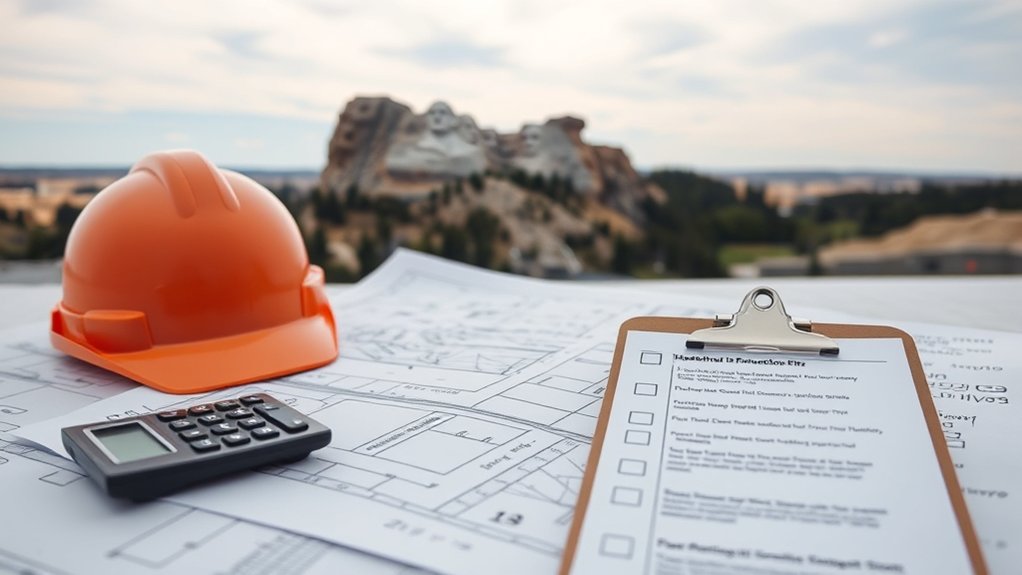
To get your contractor license in South Dakota, you’ll need to secure general liability insurance with at least $500,000 in coverage to protect against potential risks.
Additionally, a surety bond, often required in cities like Sioux Falls at $20,000, is essential to demonstrate your commitment to completing projects and following regulations.
Remember to check with your local building department for specific requirements, as failing to meet these can lead to penalties or license denial.
While maneuvering through the requirements for a contractor license in South Dakota, it’s vital to understand the importance of general liability insurance. For the construction industry, contractors must secure this insurance to protect against potential risks. Here’s what you need to know:
Understanding general liability coverage is just the beginning; securing a surety bond is equally important for contractors in South Dakota.
As a residential contractor, you need a surety bond to guarantee project completion and compliance with local regulations. In places like Sioux Falls, bond amounts often start at $20,000. This bond acts as a financial safeguard for your clients, ensuring you meet contractual obligations and adhere to legal standards.
Bonding requirements can vary, so check with local building departments to confirm specifics. Remember, failing to obtain the necessary surety bond can lead to penalties, including charges and fines for unlicensed contracting.
Meeting these requirements is essential for obtaining a contractor license in South Dakota and avoiding costly legal issues.
Obtaining a contractor license in South Dakota is a clear process that, when broken down into steps, becomes manageable. Did you know that over 60% of construction projects in the U.S. require licensed contractors? This highlights the importance of getting your credentials. By understanding eligibility, preparing documentation, guiding through local and state requirements, and passing exams, you’re setting yourself up for success in a competitive industry. Confirm you meet all insurance and bonding needs to maintain a professional edge.
Skip to content